
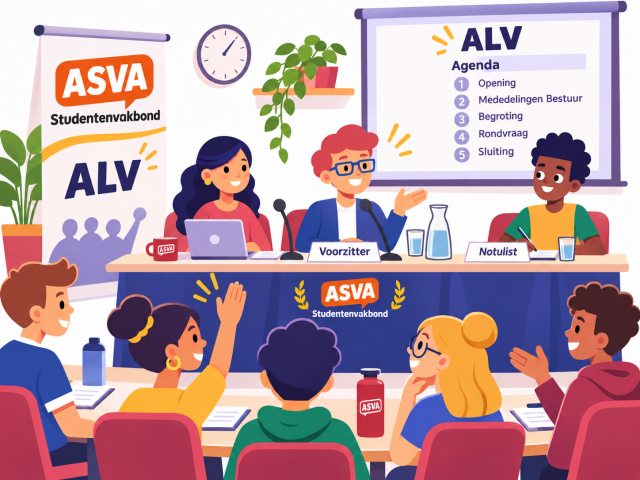
ASVA organises a General Assembly (GA, in Dutch: Algemene Ledenvergadering or ALV) six to eight times per board year.
Schedule of GAs 26|27
- October, 27th of 2026
- December, the 2nd of 2026
- February, the 2nd of 2027
- April, the 15th of 2027
- June, the 9th of 2027
- Augustus, the 25th of 2027
What is an GA?
The General Assembly, or GA, is the association’s highest governing body. Originally, the members of an association determined the association’s policy and activities for the coming period. As it is no longer practical to consult members on a daily basis regarding all manner of day-to-day matters or expenditure, a board is appointed. This takes place during the General Assembly.
The GAs are chaired by the presiding committee. The presiding committee consists of a chairperson, a vice-chairperson and a minute-taker. The chairperson chairs the meetings and ensures that voting proceeds smoothly. The minute-taker takes the minutes of the meetings; these are sent to all members. The vice-chair provides support where necessary and takes on the role of chair or minute-taker when either of them is absent.
During the General Assembly, members are kept informed of all the latest developments at ASVA. In addition, by attending the General Assembly, ASVA members can contribute their ideas and help decide on the direction ASVA takes. For example, votes are held on the board’s plans, the budget is reviewed, or members are asked to share their views on current issues.
All information, rules and standard procedures can be found in the General Assembly regulations. Below is a brief explanation of who the General Assembly are for, the powers and obligations involved, and how they are conducted.
Who are the GAs for?
Everyone is welcome to attend ASVA’s General Assemblies. However, members have greater powers:
- They are sent the documents to be discussed in advance
- They may provide input and propose agenda items
- They have the right to vote during the General Assembly
Powers and obligations of the GA

The powers of the General Assembly include:
- Amending the Articles of Association
- Appointing and removing board members
- Appointing and removing supervisory board members and – where applicable – determining their remuneration
- Granting discharge to board members1
- Approving the budget and the annual accounts
- Expelling a member
The Articles of Association stipulate that certain tasks and powers of the General Assembly may be delegated by the GA of members to committees. Examples include the recruitment committee, which selects the new board, or an audit committee.
Procedure
Two weeks before the General Assembly, all members who have indicated that they wish to receive the meeting documents2 will receive the draft documents and the agenda for the meeting. These documents may be read and comments may be made on them. These comments may be sent to the Presidium (presidium@asva.nl) or to the relevant board member.
The final documents are sent out one week before the General Assembly.3 A document must then be sent to the members for each item on the agenda. These documents provide members with detailed information about the items on the agenda. This ensures that all members are prepared for the meeting and can prepare any questions they may have.
A quorum must be reached at a General Assembly. This means that at least a certain number of ASVA members must be present in order to commence the General Assembly and to carry out certain votes.

During the General Assembly, the agenda items are dealt with. There are both informative and decision-making agenda items. A decision-making agenda item is dealt with by means of a vote. Voting on an item takes place by secret ballot, by acclamation or by a show of hands. Voting by acclamation is used when there is unanimous agreement in the room. The item is then approved by a round of applause. In the case of a secret ballot, slips of paper are handed out on which votes can be recorded. Votes may be cast in favor, against, blank or abstention. All votes are always explained during the General Assembly, so that everyone is fully informed about what they are voting on.
The General Assembly concludes with an open forum where anyone can ask questions. Afterwards, members often gather for drinks at a nearby venue to discuss matters further.
General Assembly Committees
Each year, the General Assembly appoints a number of committees:
- Presidium
- Audit Committee
- Search Committee
- Recruitment Committee
- Administration Committee
- Complaints Committee
- In addition, the General Assembly also appoints the Policy Committee, but this only takes place once every five years.
- Granting discharge is the ‘honorable dismissal’ of a board member. The General Assembly may refuse to grant discharge, for example if a treasurer has not yet finalized their annual accounts. ↩︎
- Would you also like to receive invitations and documents relating to the General Assembly? Please email the student helpdesk. ↩︎
- Would you like to view past documents? Please email the presidium. ↩︎